Sunday, May 16, 2010

Week of May 10, 2010

I hope everyone enjoyed the beautiful weekend! The weather was so nice, and I hope that it is here to stay.

First, the children are having P.E. on Tuesday, so they can meet the P.E. teacher. Please send them in sneakers and "play" clothes. If the weather is nice, they will go outside for P.E.

On Friday, the children met the music teacher. They saw, "Rikki Tikki Tembo," which was performed by the first grade students to end their unit on China. The students truly enjoyed the show! It has inspired them for our Kindergarten celebration.

In math, the students learned about the quarter. We talked about the physical characteristics of the quarter, how much it is worth, and that four quarters are equal to one dollar. We also practiced some skills that we have been working on throughout the year. We continued to work on identify coins and their values in the math workstation by playing the "Money Cube" game. I labeled a cube with 1 cent, 5 cents, and 10 cents (using the cent symbol). The students roll the cube, and pick the coin to match the value that was identified. We also practiced dividing graham crackers into halves. We also practiced writing number stories. The students could choose if they would like to write an addition or subtraction number story. For example, if a student wanted to write the following number story: 1 + 1 = 2, he/she would draw one object, then another, and count them to find the answer. The story might be, "I had one cookie at snack. I was still hungry, so I had another cookie. I had two cookies for snack. If the student wanted to write the following number story: 3 - 2 = 1, he/she would draw three objects, cross two out, and count the object that is left. The story might be, "There were three birds sitting on a fence. Two birds flew away, and one was left."

In reading, we learned that good readers ask questions while they read because this helps them understand the story better. To practice this strategy we read, "Babushka's Doll" by Patricia Polacco. I modeled this strategy for the students on our initial reading. The following lesson, I introduced, "Thick and Thin" questions. For now, we are learning about "thin" questions, which can usually be answered with one or two words. Also, the answers can be found in the book. Our goal is to ask ourselves "thick" questions because this will help us develop a stronger understanding of the story. In phonics/word study, we learned that we can use parts of words to help us solve new words. I read the poem, "Go to Bed Early" to the students. I modeled this strategy for the first two lines of the poem. The students then had to highlight the word in the first line that could help them solve a word in the next line. The students quickly noticed that the two words rhymed! That was very exciting!

In writing, we continued to practice narrative writing. I rolled a picture cube for the students, and they had to write about the picture that was identified. Before the students could write their story, they had to draw a picture. It is easier for students to write if they have a picture to use as a prompt. In addition to practice narrative writing, the students practiced using a capital letter at the beginning of the sentences and periods at the end. We also learned two lowercase letters this week, which were i and e. The language for i is: "down and dot." The language for e is: "hit the ball, run the bases, stop."

Workstations:


Writing Workstation


Listening Workstation


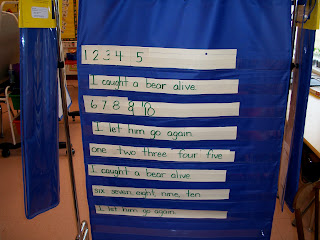
Pocket Chart Workstation


Handwriting Workstation


Overhead Workstation


Library Workstation

Sunday, May 9, 2010

Week of May 3, 2010

I hope everyone is having a wonderful weekend and Mother's Day! It is much deserved!

The students had two exciting events take place this week. First, they met Ms. Austin, the art teacher, on Wednesday. They had a great time painting, "Upside Down Flowers,"which prevented them from getting too messy. The students painted their flowers upside down, and when their pictures were complete they turned their papers. The flowers were no longer upside down! Second, the students participated in the used book sale. The students had a great time spending their quarters!

Despite these two exciting events, the students worked very hard in the classroom. We learned several new concepts in math. First, we learned about dividing objects in half, and the students know this means that the two parts must be equal in size. The students are going to continue working with dividing things in half next week. We also played a game called, "Read My Mind," which required the students to guess the attribute block that I was thinking of by asking, "yes or no" questions. The students also practiced skip counting by 2's, 5's, and 10's on the calculators. Lastly, the students learned that you can represent a pattern with symbols. For example, if the pattern was touch your head, clap your hands, touch your head, clap your hands, etc., you could draw the following: l l x l l x...

In reading, we practiced using the three questions that good readers ask themselves when they get stuck on a word: 1) "does this makes sense?" 2) "does this sound right" 3) "does this look right?" We also practiced looking at pictures to help us figure out a tricky word. We practiced this in a whole group with the story, "A Clean House for Mole and Mouse." In guided reading, we also continued to practice our sight words and letter sounds.

In phonics and word study, we continued practicing the concept of changing the first letter of a word to make a new word. To do this we read, "Hop on Pop" by Dr. Seuss. Without showing the pages to the student, I would say the first word on the page, the students would then have to tell me other words that we could spell by changing the first letter of the word. After we brainstormed a list of several words, I would show the pictures to the students and read the rest of the page.

In writing, we wrote in our journals, so we could practice using a capital letter, spacing between our words, and a period at the end of the sentence. The students shared their journal entries with the class at the end of writing. We also made Mother's Day cards. The students worked very hard on these and wanted to make sure the cards were perfect. In handwriting, we learned how to write the lowercase g and u. The language for a lowercase g is as follows: "magic c, up like a helicopter, back down, turn." The language for a lowercase u is as follows: "down, travel, back up."

I have to apologize for not posting any pictures. Our week was so busy that taking pictures slipped my mind. I will try to post more pictures next week to make up for the lack of pictures this week.

Sunday, May 2, 2010

Week of April 19, 2010

I hope everyone has enjoyed the break. I took some time to visit my family and friends with Lilly and Mr. Keane. Needless to say, I've enjoyed the time off and apologize for not posting the blog sooner.

First, I have a housekeeping note. I received most of the report cards, however, I am still waiting on a few. If you could sign the report card and return it as soon as possible, I would greatly appreciate it.

Despite the excitement of the approaching break, the students really worked hard to stay focused and understand the new concepts that we learned.

In math, we practiced making exchanges with coins. Each student had about 20 to 25 pennies, and they had to request an exchange or a trade for a nickel or a dime. After we practiced exchanging coins, we looked at the different combinations we could make with pennies and nickels to have the equivalent of a dime. The students and I worked on counting by 2's. We counted our feet by 2's. In addition, we brainstormed a list of all the things we could count by 2's. Their ideas include eyes, hands, arms, elbows, and knees. We also worked with comparison number stories. To practice this, each student had a mini dry-erase board and a marker. I would tell them a story, and they would have to draw dots to represent the story. For example, I said, "Ana invited six friends to her birthday party. She had seven invitations. Does she have too few or too many invitations? How many extras does she have?"


The students draw six dots first. Then they draw seven dots (making sure to line the seven dots up with the six dots).


Then they cross out the dots to determine if there are any invitation left over, and if so, how many.

In reading, we continue to practice our letter sounds, rhyming words, and our sight words. We learned that readers ask themselves three questions when the come to a word that they don't know. These three questions are: 1) Does this word make sense?, 2) Does this word sound right?, and 3) Does this word look right? These questions can be asked by the reader after they have attempted to determine what the tricky word might be. To model these questions for the students, I read "Frederick" by Leo Lionni. In word study, we continued to practice making new words by changing the first letter of the word. We used the word, "it" as our base word. Other words that we made include: fit, sit, hit, kit, bit, and lit.

In writing we learned how to write a narrative story. I had a story cube with the words: princess, dragon, flower, birthday, castle, and singing. The cube was rolled, and as a class we determined how the word would influence our story. After our stories were complete, the students created an illustration to accompany the story. I am going to type the stories and hang the pictures in the hallway because the students did such a great job! We also practiced writing a lowercase a and a lowercase d.

In science, we cleaned the playground for Earth Day. The students were very excited to help clean-up in support of Earth Day. We also talked about all of the things we can do to help keep the planet clean and healthy.

In social studies, the students completed a T-Chart that categorized items that are needs and wants. The students completed this task individually and demonstrated that they have a strong understanding of needs and wants.


Workstations:


Handwriting workstation


Pocket Chart workstation


Writing workstation


Overhead workstation

Sunday, April 18, 2010

Week of April 12, 2010

The students continue to work hard and are learning a lot of new things.

In math, we learned about the dime and reviewed the penny and the nickel. We also played, "I Spy" with two-dimensional and three-dimensional shapes. To play, "I Spy" I gave clues that described items that can be found in the classroom. For example, I would say this shape is a three-dimensional shape and can be used for writing. The student would then identify the marker and tell the class the shape. The students also practiced one-to-one correspondence with the "tricky" teens at the math workstation.

In reading, we continue to practice our sight words during our class meeting and during guided reading. The students also learned how to create sensory images while reading, which helps with reading comprehension. To practice this strategy I read, "Pancakes, Pancakes" by Eric Carle. As I read, I modeled how to create a sensory image using the five senses. After I modeled this several times, I encouraged the students to create sensory images as I read. The students seemed to really enjoy working with this strategy.

In writing, we created a book about the four seasons. Also, we talked about the components of a sentence, which include a capital letter at the beginning, spaces between each word, and a period at the end of the sentence. We created several sentences together during a whole group lesson. The students could then practice rearranging the sentences while at the pocket chart workstation. The students also learned how to write the lowercase v, w, and t.

In social studies, the students learned about needs and wants. During a whole group lesson, the students and I worked together to sort pictures on a T-chart that was labeled, "needs" and "wants."

Pictures of workstations:


Sorting pictures by the beginning sounds at pocket chart workstation


Writing about a tree house the students would like to build at writing workstation


Practicing corner starter letters at handwriting workstation


Building "ay" words and finding pictures with short i at ABC/word study workstation

Sunday, April 11, 2010

Week of April 5, 2010

First, I would like to take care of a few housekeeping notes. I want to apologize for the confusion with the book order from last month. When I received the initial shipment, half of the order was missing. I contacted Scholastic, and they sent the remaining orders. At this point, everyone has their books. I will not be using the online ordering option in the future because that was the root of the problem. Also, report cards will be going home this week.

The students continue to work hard each and every week. This week was no exception. We learned several new concepts in math and writing.

In math the students learned about the nickel, three-dimensional shapes, and counting beats to keep time. The students learned that a nickel is worth five cents, that it is silver, bigger than a penny and dime. The students also learned the difference between two-dimensional and three-dimensional shapes. The three-dimensional shapes that we learned about include the sphere, the cube, and the cylinder.

In writing, the students learned about informational writing. As a class, we wrote about the process we completed to plant our green bean seeds. In science, we illustrated the book that details the process. In reading, we learned that the illustration on a page help tell the story, so the pictures should match what is stated in the writing. Also, we worked with rhyming words by using the word "an" to build other words. In phonics and word study, we learned that we can locate number words in text. Each student had a number word, and they had to find its match in the poem that is pictured below. Once the child found the match, we worked together to make sure the two words matched by checking letter by letter.


Building rhyming words using the word "an"


Locating number words in text

In science, we completed two more pages in our plant journals and measured our plants. The little boxes on the right-hand side of the page are equal to one inch. For example, if six boxes are colored in, the plant is six inches tall.


This is the first page of our book about the process we completed to plant our green bean seeds.


Workstations:


Art Creation


Computers

Sunday, April 4, 2010

Week of March 29, 2010

The weather has been absolutely gorgeous this weekend, and I hope you are enjoying it! I think Spring has finally arrived.

The students worked very hard this week and learned several new concepts.

In math, the students were introduced to the number grid. They learned how it helps the count by 5's and 10's. To help reinforce this idea, the students played, "The Number Grid Game." To play, you need a copy of the number grid, a die, and a game chip or bean for each player (these are used as game pieces to keep track of each players moves). The first player rolls the die. If the student lands on a 1, he/she can move one or ten spaces. If he/she lands on a 2, he/she can move two or twenty spaces. The other numbers (3-6) can only be moved that number of spaces. The first person to 110 wins. We only played to 50. The students were also introduced to the penny this week. We observed the characteristics of a penny (its size, shape, color, and other features on the penny). We also discussed how much the penny is worth. Lastly, we talked about the "cents" symbol, and that this is the quick way to write the word, "cents."


Playing, "The Number Grid Game"


Drawing our pennies in our math workbooks


In reading, we practiced a small group discussion technique called, "Turn and Talk." To practice "turn and talk" we read a story about an Easter egg hunt. We also practiced building words. We started with the word, at. Each child had a letter that would make a word that ended with at. We made the following words: bat, cat, fat, hat, mat, pat, rat, and sat. We practiced sounding out the words. We also made the words plural by adding an s. In writing, we practiced responsive writing. I read, "A Pocket for Corduroy" by Don Freeman. After I read the story, the students had to write about their favorite part. We also practiced writing the lowercase s this week. In phonics and word study, the students learned how to match number words with the correct numerals.


Workstations:

Overhead workstation


ABC/Word Study workstation


Pocket Chart workstation


Sunday, March 28, 2010

Week of March 22, 2010

The students were busy bees again this week. We learned a lot of new things!

In math, we practiced measuring with a ruler. The students were allowed to measure anything in our classroom. After we had time to practice our measuring skills, we shared all of the things that were measured. We also learned how to add and subtract using our calculators. This was a challenge for the students because it required a multiple step process along with pushing the correct buttons. Also we played a game called, "The Attribute Spinner Game." This game reinforced finding a specified object according to a certain characteristic.


In reading, we had a two-part focus lesson for Reader's Workshop. We talked about finding a "just right" spot for our independent reading time. In order for a spot to be "just right" it has to be quiet and comfortable. The students had an opportunity to try two different spots in our classroom to decide which spot would be best for them. In addition to Reader's Workshop, we practiced reading skills during guided reading, which include making sure the words we say match the text on the page, sounding out unknown words, and using the picture clues to help us solve unknown words. We also practiced our sight words during Phonics and Word Study by building the words with magnetic letters, checking the word, and writing it. Also, we wrote in our journals and practiced writing the letters J and c in handwriting.

In Science, we started learning about the Scientific Method. The Scientific Method has five components, which include 1) identifying the problem, 2) making a hypothesis, 3) conducting an experiment, 4) observing the experiment, and 5) analyzing the results from our observations. To practice the Scientific Method, we are going to grow green bean plants in our classroom. The students and I worked together to determine what the problem is. The students and I decided our problem would be, "what do plants need to grow?" We hypothesized they need a seed, water, air, sun, and soil. To conduct our experiment we planted the green bean seeds. Now we will observe the seeds as they sprout and conclude by analyzing our observations.

Workstations:


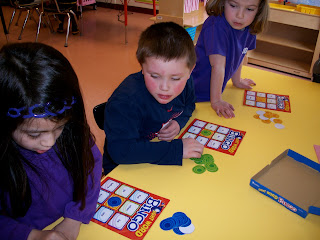
ABC/Word Study: Sight Word Bingo


Writing: "Things I Taste" writing prompt


Math: Practice writing the numeral 5


Art Creation: Making a chick